-
DALLAS INVITATIONAL 2026
-
Susan Inglett Gallery is proud to be exhibiting this Spring at The Dallas Invitational. Founded in 2023 and created from conversations between galleries, collectors, and curators, the fair features a selection of international contemporary art galleries, showcasing works from emerging and established artists.The Dallas Invitational 2026 will be held at the iconic hotel, Rosewood Mansion on Turtle Creek, from Thursday to Saturday, 16 - 18 April 2026, from 11 AM to 6 PM daily.
-
HOPE GANGLOFF
Hope Gangloff is well-known for her portraiture, capturing the bohemian lifestyle of the artists, musicians, and writers in her close circle of friends. Texans may remember her for her memorable contribution to the Fort Worth Modern's Women Painting Women, Queen Jane. A recent move to Beacon, NY, inspired a shift towards landscape painting, celebrating nature and the charm of country living. Recognized for her vibrant colors and intricate linework, she documents quotidian moments, elevating and immortalizing the simple pleasures in life. -

-
Bittersweet Barn serves as a quiet tribute to Gangloff’s upbringing and artistic roots. Its subject matter recalls a childhood in Amityville, New York where she spent many happy hours painting in the attic of the family's barn. As with much of Gangloff’s work, the subject matter feels intimate and reflective, allowing the viewer to see through her eyes and experience a place infused with memory and meaning.
-
In the broader context of portraiture's evolution, Hope Gangloff’s work occupies a compelling intersection between tradition and modernity. Her painting James (Case-Leal) captures what appears to be an unguarded, everyday moment that is reminiscent of the spontaneous intimacy often found in smartphone snapshots. Yet, despite the casual subject matter, the piece is executed with the technical mastery and Hope’s hyper-saturated style. This tension between immediacy and craftsmanship is central to Gangloff’s oeuvre. Her portraits often feel like glimpses into private snapshots of relationships and quiet observations that collectively reveal the emotional texture of her world.Gangloff often paints those closest to her: friends, family, and neighbors; rejecting the historical tradition of portraiture being reserved for the elite. In Arnold (Lehman-Richter), the subject is seen lounging beside Lake George, casually enjoying a moment of rest and leisure. Gangloff and a group of classmates from Cooper Union have traveled up to the lake every summer since graduation to reconnect with nature and each other. Though the group has grown over the years, now including spouses and offspring, the bond remains constant. The work exemplifies Gangloff’s approach to portraiture: informal, unguarded, and deeply human. Rather than idealizing or mythologizing her subjects, she captures them as they are, inviting viewers to see beauty and significance in the everyday. In doing so, she democratizes the portrait, turning ordinary people and moments into enduring works of art.
-
MAREN HASSINGER
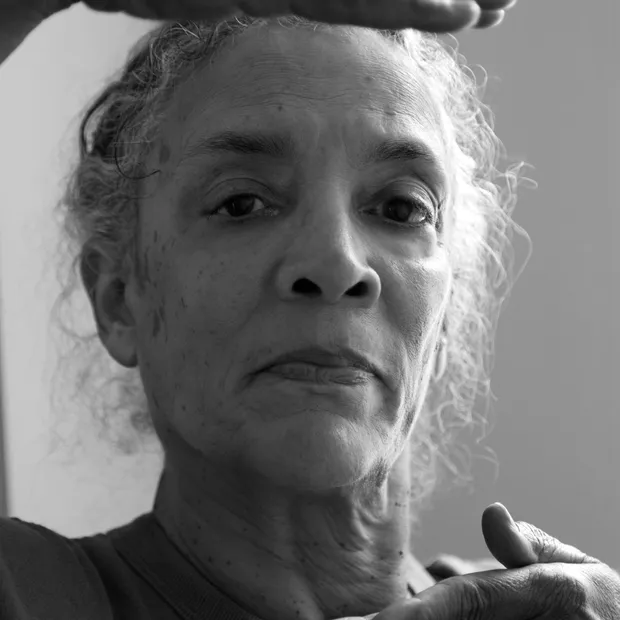
Maren Hassinger has built an interdisciplinary practice that articulates the relationship between nature and humanity. Her work festooned the entrance to the Nasher Sculpture Center during Groundswell : Women of Land Art in 2023 and she is currently preparing for a career retrospective originating at the Berkeley Art Museum this June. Hassinger's choice of material is either taken from or mimics nature using industrial materials, in this case her signature wire rope. Hassinger's multifarious practice explores the subjects of movement, family, love, nature, environment, consumerism, identity, and race. -
-
Garden was originally commissioned as a temporary installation for the roofdeck of the Aspen Art Museum. Here you see the multi-unit wire-rope sculptures burst forth from the rooftop's planters, acting as an unwieldy vine among the existing flora and fauna. Hassinger manipulates rope and cable in a fiber-like manner to create sculptures that resemble "living, breathing things." Composed of synthetic stand-ins for organic matter, Hassinger's sculptures confront and balance the natural and the manmade. Whether an homage to the natural world or a cautionary tale, remains to be seen.
-
-
ROBERT KOBAYASHI
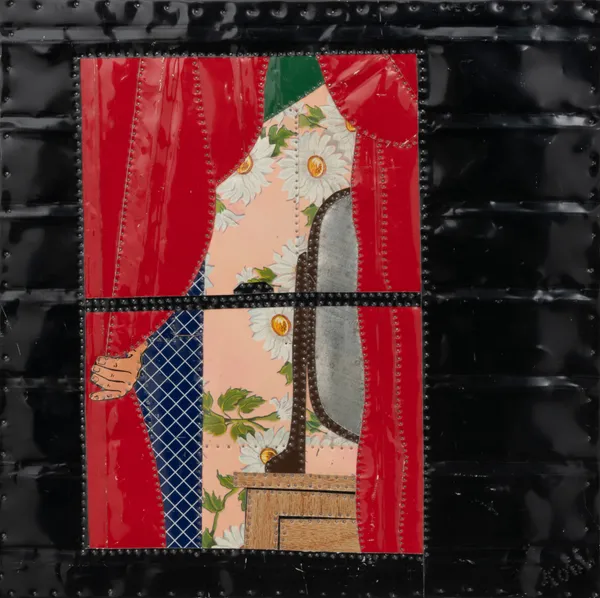
Japanese-American Robert Kobayashi moved to New York following his service in WWII, studying at the Brooklyn Museum School and falling in with the AbEx movement that dominated the scene in the Fifties. Once established, Kobi abandoned abstraction to follow his true passion, Impressionism. In 1978, the artist purchased a building in Little Italy, transforming the former butcher shop, Moe’s Meat Market, into a studio/gallery. There, he developed his distinct mixed media style dubbed “clouage,” composed of strips of ceiling tin discarded as the neighborhood became gentrified. Kobayashi juxtaposed the hard sharpness of his materials with a unique whimsy, producing colorful and dreamlike "impressionist" paintings. -
If you’ve never been to Ohio in the summertime, (Dad) captures it perfectly within the piece. The landscape has unbroken miles and miles of sky and clouds, and if you’re standing on a patch of field that isn’t farmed or mowed, waist-high grass moves like the tide. There is a feeling of encroachment or oneness—a total sinking into the experience of being wind-blown and without the din of airplanes or helicopters that is unremitting in a city...The setting (Johnny Boy Lived There) feels like a blend of his work named after Ohio and its open skies. Dad’s landscape lacks the ever-present backdrop of the mountain ridge of Oahu, but it certainly captures its cloud formations. It feels like he was straddling two of his scenic daydreams at once: the sky vista of the Midwest and the architecture of his childhood—a bygone era of Hawaii that predated rampant tourism. The street he grew up on still exists, but it’s surrounded by a 4-lane highway and strip malls. High rises compete with the mountains, and Honolulu became, in his words, “a city of cranes.”- Misa Kobayashi
-
Morning Light is a work I had never seen in person until it resurfaced a few years ago. It looks both like and unlike his other tin pieces; it lacks the thousands of perforations of nails as its borders are a neat trim, and the tin itself is from preexisting vessels that were not painted by him. It is conceivably more of a painting than a sculpture, but it retains a stillness poised for an entrance that a lot of his other works have.- Misa KobayashiFrom the same period, Brothel is of similiar construction though this work shows evidence of contributions from the neighborhood children. Their scavenging might well have played a role in the composition of Brothel, with its found printed tin, floral and hatched “wallpaper,” the use of brushed tin for the mirror is similarly inspired.
-
-
MARCIA KURE
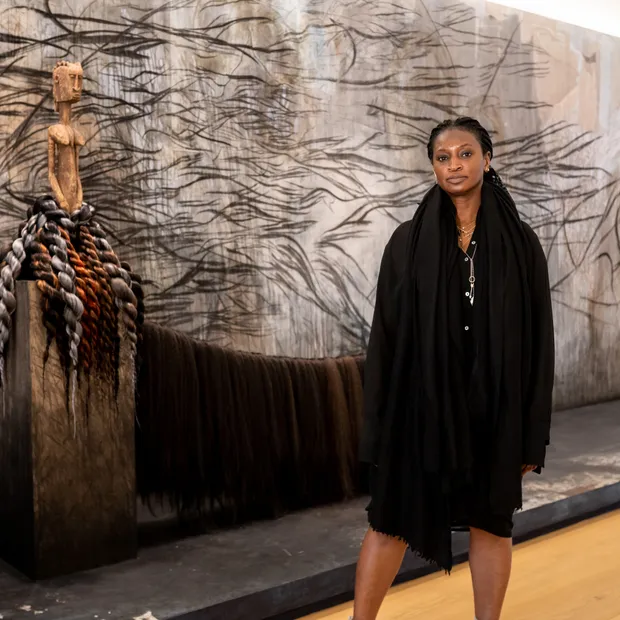
This Spring Marcia Kure will be included in The 61st International Art Exhibition of La Biennale di Venezia, In Minor Keys curated by Koyo Kouoh. She is known in Texas as the third artist selected to participate in the Menil Drawing Institute's Wall Drawing Series. Kure repositions drawing as a system of inscription through which materials are condensed, rerouted, and made to bear weight. She engages synthetic hair, indigo, kola nut, and gold as active agents within systems of circulation and material exchange. Her practice approaches substrate not as passive surface but as infrastructure, a site where histories accumulate and spatial relations are pressurized and reorganized. -
Following her commissioned site-specific installation NETWORK for the Menil Drawing Institute, Marcia Kure continues to explore the complex histories of trade and migration through painting, sculpture, drawing, and collage. Through abstraction, Kure asks how visible and invisible structures can be dissolved into line. Reticulation investigates our shared responsibility in perpetuating networks of migration and exchange. Kure uses line as a mark, metaphor, memory, and systems tracker. Using natural pigment—indigo and kola nut—the artist places pressure on the material components of her drawings as commodities that map the movement of bodies through time.
-
Employing a labor-intensive technique of soaking and staining, this work on paper manifests as the physical embodiment of time and underscores the artist’s relationship with nature, yet another system of exchange. In a painstaking process, Kure invites the labor of seasons to partake in the creation of her works. Kure titled this series of work on paper in a hyper-specific way, combining Bamum (Shümom) script with code. Historically used to record, organize, and transmit knowledge, Bamum is placed in relation to contemporary computational systems, where language operates not as a fixed structure but as a process. Drawing, writing, and code converge as interdependent technologies that synthesize the production and distribution of knowledge. The presence of Bamum situates the work within a longer history of inscription, while extending it into contemporary logics of computation, where power operates through abstraction, data, and the regulation of information.
-
ROBYN O'NEIL
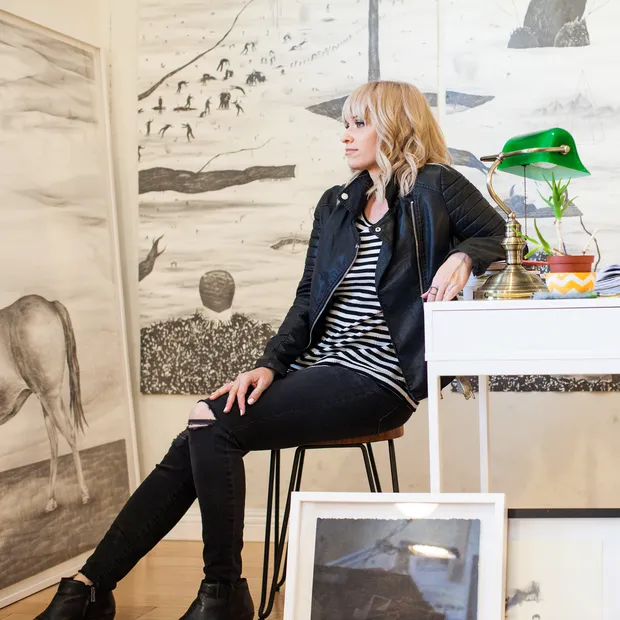
Robyn O'Neil was celebrated with a monumental survey show of twenty years of work at the Fort Worth Modern 2019-2020, We, The Masses. O'Neil is well known for her work on paper whose monumental narratives straddle the line between comedy and tragedy. Her extensive oeuvre excavates memories and art historical references to populate large-scale graphite landscapes. These works are rendered in exquisite detail, displaying a commitment to craft and technique, while contributing to her distinct style of worldbuilding. -
After a move from the urban centers of Houston and Los Angeles, Robyn O'Neil is now happily embedded in the hinterlands of the Pacific Northwest. Looking to Nature as refuge and resource, the artist turns her attention to the most iconic creatures of the American ecosystem. Here eagles, bison, and wolves are rendered onto hotel stationery, serving as a playful reminder of places visited and the passage of time. These works serve as an evenhanded understanding of the world through a Janusian balance of horror and humor. The artist’s landscapes are a scholarly mélange of art-historical references ranging from George Tooker to Fra Angelico to Frederic Edwin Church. There is hope to be found here, and it lies in continuous exploration — in observing human history and learning from it.
-
-
Born and raised in Tornado Alley, the force and power of the elements made a lasting impression on the artist. O'Neil's work is quite simply a study in the sublime, rendering a Nature that is as awful as it is awesome. That terror and beauty is captured in the intensity of this storm as amplified by O'Neil's battering pointillist mark.
-
Everybody loves something, even if it’s only tortillas.
In the garden of gentle sanity,
May you be bombarded by coconuts of wakefulness.- From the Buddhist teachings of Chögyam Trungpa RinpocheThis graphite drawing looks back to O'Neil's earliest work, imagining a world populated by sweat-suited men engaged in various banal, no doubt futile, activities. Whether this is the beginning or the end of the world, the artist never says. -
RYAN WALLACE
Ryan Wallace has developed a rich process-based practice wherein each body of work leads to the next in terms of materials and composition. Repurposing fragments from earlier and developing pieces, the artist seams, layers, excavates, and manipulates the surface of his work to incorporate a wealth of textures and techniques. This series of watercolors was executed over two consecutive summers. Without access to a large studio, Wallace embraced the materials at hand and began to experiment with a medium he thought he had left behind in art school. His efforts land in this free-flowing series of color and brush stroke that seem to embody the joy of their making. -
On a run after the first snow of the year, I looked down into a pile of ice broken up by salt and mud. The marks and shapes appeared like a grim winter version of the pigment pools I’d been setting down in the studio. This sidewalk composition lacked the authorship that I had been working to imprint and called back the ease I saw in the Richters. I suddenly knew where I was heading. This experience acted almost as a grounding synapse, one that had propelled so many paintings before and allowed me to break free of whatever rigor came before. I let the paper buckle and dictate where the paint flowed. I embraced the underpainting revealed with each erasure and revision.While I continued to make the canvas works that I had returned to with fresh insights, I found I could not fully put away these new works on paper. I was determined that they should find their way. Much like when a canvas is complete and stretched, a painting will reveal itself. By removing these watercolors from the chaos of the drawing table, I could see these works for what they were. Held aloft from the madness, they revealed an energy all their own. Memories of the ocean, nature trails, and winter light were all embedded in these modest slips of paper.- Ryan Wallace
-
-
-
-
-
-
DALLAS INVITATIONAL 2026: ROOM 106
Current viewing_room